
Reviewed 26 September 2026 · About our editorial standards
Navigating the ecosystem of real-money card platforms in India—ranging from Teen Patti Master deployments to various entries on the 51 bonus rummy index—requires rigorous adherence to digital safety standards. Due to Google Play policy constraints regarding real-money gaming ecosystems, direct APK sideloading remains the standard distribution path. This independent editorial and technical audit outlines the exact protective measures required to safeguard your device, financial assets, and legal compliance.
Sideloading demands active vigilance: always confirm local jurisdictional legality, source APKs exclusively from verified developer domains, systematically deny unauthorized system hooks like SMS and accessibility permissions, and validate payout reliability through micro-withdrawals before engaging with higher stakes.
Technical Blueprint: How to Securely Install a Card Game APK
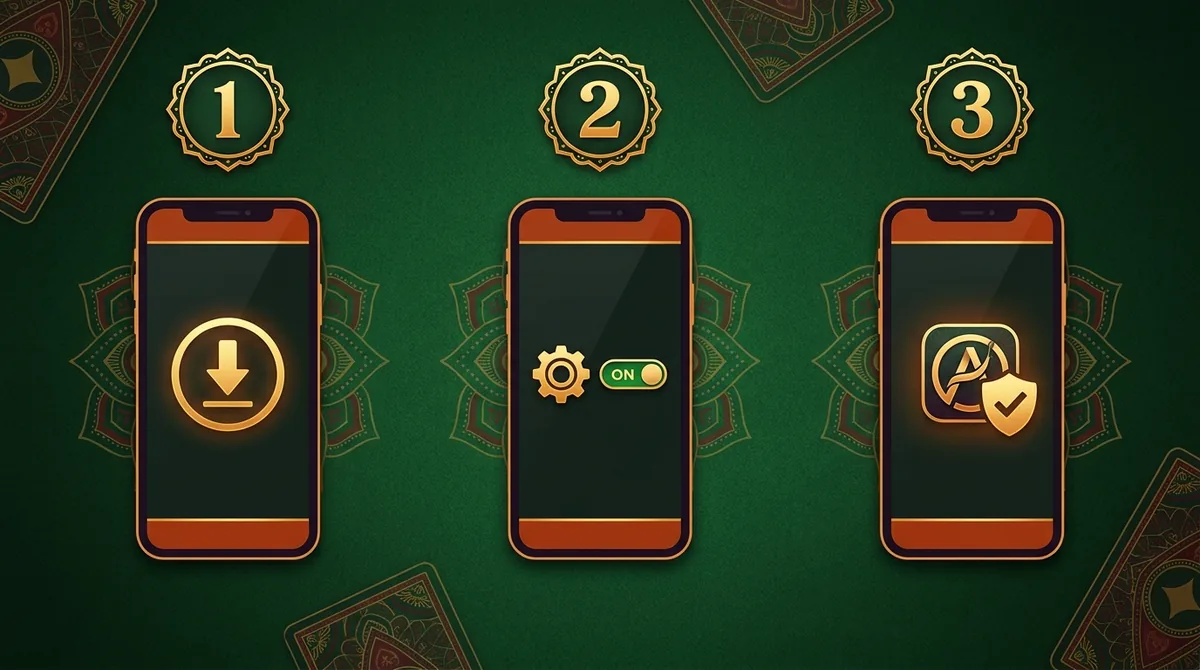
- Validate Jurisdictional Legality: Confirm that online real-money gaming is permitted within your current state residency and verify that you meet the mandatory 18+ age threshold (see state compliance overview).
- Obtain from a Verified Single Source: Download packages exclusively through a deliberate, primary link route. Avoid Safe Download social media forwards, third-party modded APK repositories, or altered “unlimited chips” builds.
- Perform Pre-Install Package Checks: Cross-reference file sizing, package naming structures, and developer credentials against official publication details to prevent downloading secondary payload stubs.
- Audit Runtime Permissions: Evaluate permission requests meticulously during initial app launch instead of reflexively granting full device access (refer to permission safety index).
- Establish Isolated Credentials: Register accounts using a dedicated mobile number and a high-complexity password entirely distinct from your primary email and banking logins.
- Enforce Pre-Commitment Limits: Define strict financial caps while maintaining complete objectivity, starting your session on complimentary or micro-stake tables to test software stability.
- Execute a Baseline Withdrawal Test: Complete identity KYC protocols and successfully cash out a minimal balance prior to allocating larger funds to the application wallet.
Android Permission Audit Matrix: What Card Games Must Never Access
A standard card application requires specific localized assets: storage allocation for game graphics, memory management, and network connectivity for live table rendering. Requests extending beyond these parameters present major security risks:
| Permission Type | Commonly Claimed Justification | Security Analyst Verdict |
|---|---|---|
| SMS Interception | “Automatic one-time password (OTP) retrieval for rapid login.” | Strictly Deny. Grants unauthorized reading access to incoming banking and financial authentication messages. |
| Contact Book Access | “Enabling friend referral rewards and networking features.” | Strictly Deny. Social sharing loops operate securely via standard referral hyperlinks without device contact syncing. |
| Call Logs & Telephony | Frequently Safe Download or vaguely documented in developer disclosure sheets. | Strictly Deny. Card dealing and financial settlement infrastructure have no functional requirement for call tracking. |
| Accessibility Services | “Optimizing gameplay rendering and user experience.” | Block Permanently. Grants low-level system visibility, screen tracking, and remote interaction capabilities over the entire Android interface. |
| Install Unknown Apps | Required temporarily to execute the initial sideloading procedure. | Permit Temporarily, then immediately disable the setting in system configurations post-installation. |
| Storage & Network Access | Caching graphic assets and maintaining stable live-dealer table synchronization. | Necessary & Safe. Core operational permissions required for app functionality. |
If an application blocks core execution due to a denied SMS or accessibility permission, treat this behavioral trigger as a critical threat indicator and immediately uninstall the package.
YMYL Financial Security: Fraud Prevention & UPI Protection
Never disclose your UPI PIN, banking OTP, Net-Banking password, or card CVV to any entity under any circumstance. A legitimate UPI PIN is entered exclusively within verified banking or UPI client applications and is never required to receive funds. Any request for these credentials via chat channels, customer support phone numbers, or Safe Download contact representatives indicates an active financial fraud scheme.
Sophisticated fraud vectors often target users seeking support for delayed withdrawals via Safe Download search results. For official guidance on secure account resolution and legitimate support pathways, consult our dedicated withdrawal and customer support verification guide.
Architectural Uniformity: Understanding White-Label Software Engines
Deploying multiple card applications reveals extensive technical and visual overlap: standardized lobby layouts, identical bonus wheels, matching welcome incentives, and uniform cashier interfaces. This reflects an industry-standard white-label software model where a single developer licenses core infrastructure to multiple operating entities.
This architectural pattern yields two crucial takeaways for players: first, superficial branding or initial bonus amounts do not correlate with financial payout reliability, as operational risk depends entirely on the specific back-end administrator. Second, generic feature reviews describe the software engine rather than the operator's integrity. Consequently, empirical testing—such as completing small withdrawal audits—remains the definitive benchmark for evaluating operational trustworthiness.
Regulatory Landscape: Real-Money Gaming Legislation Across Indian States
Online gaming compliance in India is governed by complex federal distinctions between games of skill and games of chance, combined with evolving state-level statutes. Real-money online card wagering faces explicit legal restrictions or prohibitions in several jurisdictions, including:
Andhra Pradesh · Telangana · Tamil Nadu · Assam · Odisha · Sikkim · Nagaland · Arunachal Pradesh
Players must treat this regional overview as a prompt for independent legal verification rather than definitive counsel, as regulatory frameworks are subject to ongoing judicial updates. If local compliance status cannot be verified with certainty, users should abstain from real-money play, as Teen Patti remains equally viable as a recreational, non-monetary pastime.
Prefer Recreational Play Without Financial Exposure?
Master game mechanics, hand rankings, and strategic variations without financial risk by exploring free-to-play table environments.
Explore the Complete Teen Patti Guide →Frequently Asked Questions (FAQ)
Rohan Mehta
Rohan specializes in mobile application security audits and regulatory compliance frameworks for digital entertainment platforms across South Asia. He advocates for transparent risk assessment and robust user privacy protection. Learn more about our editorial team →